


Air conditioning warranty requirements

TL;DR: To keep air conditioning warranties valid, you must register the unit within 30 days and document annual servicing by an F-Gas engineer.
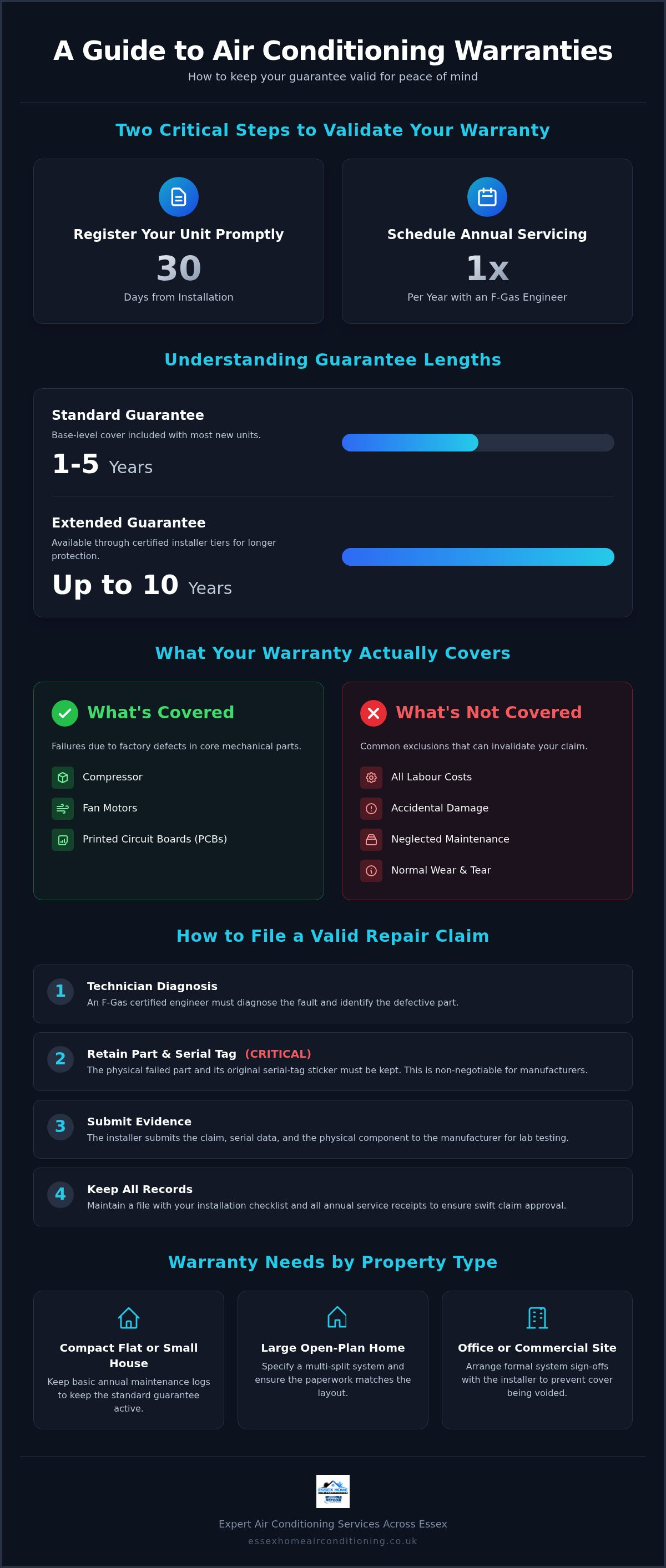
Certified installer tiers can extend standard 1–5 year guarantees up to 10 years.
Standard coverage excludes all labor costs, accidental damage, and failures caused by neglected maintenance.
Register your unit and file claims through the original installer to ensure paperwork compliance.
The physical serial-tag sticker from the failed part is required for manufacturer lab testing. Standard residential air conditioning installation costs vary across the UK market, but keeping your 5 to 10-year guarantee (manufacturer warranty) valid requires strict adherence to annual servicing. You must also complete prompt registration within 30 days of setup. The decisions that matter most are which setup matches your property, what the manufacturer actually covers, how long protection runs, whether extra cover is worth buying, and how to file a claim without gaps in the paperwork.
Table of contents
Match warranty setup to your property type
Typical situations and a concrete next step for each:
A compact flat or small house on a single-split system: keep basic annual maintenance logs and register within 30 days so the standard guarantee stays active.
A large open-plan home that behaves like a heat sponge: specify a multi-split network at install so the extended paperwork trail matches the equipment layout.
A multi-story office or light commercial site: arrange formal system sign-offs with your installer; complex buildings lose cover faster when those records are missing.
Residential spaces usually need simpler validation rules than commercial buildings. Homeowners work with basic annual maintenance logs, whereas multi-story offices need complex system sign-offs to prevent losing your coverage (voiding the warranty). Choosing the right setup protects your investment without forcing unnecessary paperwork. You can arrange professional Air Conditioning Installation Essex | From £1,338 Fitted services that align directly with your building's rules of the warranty (warranty terms and conditions).
Smaller homes run smoothly on simple single-split setups. Large open-plan spaces need multi-split networks with extended rules. Submitting a warranty claim for repairs stays straightforward when your installer correctly files the initial sign-off paperwork from day one.
Pay attention to what is not covered (exclusions) on your contract. Skipping routine air filter care often invalidates extra coverage (extended warranty) protection faster than component failure. Keep every service receipt. Our engineers routinely complete thorough system checks across domestic and light commercial sites.
A commenter in the trustatrader.com thread "Find the most trusted local Air Conditioning Services in Essex":
"George & his team were very efficient in fitting our new Toshiba Split System at home." (source)
Expert fitting by certified technicians keeps protection active under standard manufacturer terms and reduces unexpected service issues.
Manufacturer cover focuses on core mechanical parts
Essential internal mechanical parts, such as compressors, fan motors, and printed circuit boards, are shielded from factory defects by a standard manufacturer warranty.
PARTS CLAIM PROCESS +-----------------------------------------------------+ | 1. Technician Diagnoses Defect & Replaces Part | +-----------------------------------------------------+ | v +-----------------------------------------------------+ | 2. Remove Serial-Tag Sticker & Retain Old Component | +-----------------------------------------------------+ | v +-----------------------------------------------------+ | 3. Submit Serial Data & Physical Part for Testing | +-----------------------------------------------------+
During a request for repair (warranty claim), proving component origin requires physical evidence. You must provide the original serial-tag sticker clipped directly from the failed component casing. Manufacturers run lab diagnostics on returned parts to confirm internal mechanical failure rather than external electrical surges.
Failure to return the physically defective part along with its matching serial tag leads to losing your coverage for that specific component repair. Under the Magnuson–Moss Warranty Act of 1975, manufacturers must clearly spell out these documentation rules before denying coverage.
Treated as retained technical evidence, the physical pieces document the failure path for the lab. When you need to clarify rules of the warranty for your system, CONTACT our experts for guidance. Professional processing keeps extra coverage secure and limits disputes over what is not covered.
Tip: Keep your original installation benchmark checklist and annual service receipts signed by an F-Gas engineer in a single digital folder to ensure instant claim approval.
Labour, wear and neglect sit outside standard cover
Standard coverage excludes normal wear, accidental damage, neglected maintenance, and any labour fees associated with replacing broken components.
A frequently overlooked detail: missing annual service receipts instantly invalidates a claim, given that producers demand written evidence of yearly maintenance. Neglecting simple tasks like cleaning filters can trigger air unit failure, which leaves you paying entirely out of pocket.
Relying solely on standard coverage is a risky strategy because labour fees often cost far more than replacement parts. Purchasing an extended warranty guards your finances from those unexpected call-out costs.
What is not covered can catch system owners off guard. Standard coverage protects against factory component defects, not external issues like power surges or bad installation. For reliable system care, explore SERVICES | Essex Home Air Conditioning. Local Air to maintain your setup correctly.
Losing your coverage happens fast if unapproved tradespeople tamper with the unit. Read the rules of the warranty carefully before making a request for repair. Every guarantee has strict limits.
Certified installer tiers stretch guarantee length
A standard guarantee usually lasts between one and five years, but certified installer tiers can grant up to ten years of protection.
In installation work we regularly observe that homeowners overlook how brand partnerships alter coverage timelines. Premium D1 partners can offer extended coverage because manufacturers trust their technical training. Based on European public procurement standards outlined by the EU Publications Office 2024, long-term system reliability directly depends on strict compliance with initial setup protocols. Standard uncertified fits only get basic baseline terms.
While a basic installation carries shorter terms, higher installer tiers give you far longer security on the same equipment. You can learn more ABOUT our qualified team and process to see how certified fitting protects your investment.
Market costs for residential system fits vary based on unit capacity and home layout, so a personalized quote for your space is the practical next step. Basic coverage suits short-term property owners, whereas long-term coverage fits permanent residences. Skimping on maintenance risks losing your coverage entirely.
Among the company's Google reviews, George (5★) wrote:
"Excellent service, the team were very friendly and accommodating, they completed the installation in 3 rooms in one day. They cleaned up after themselves and left no mess, we barely knew they had been apart from the working aircon they left us with!"
Fast, clean multi-room setups show how professional installations secure long-term guarantee terms without hassle.
A commenter in the trustatrader.com thread "Find the most trusted local Air Conditioning Services in Essex":
"TT Cooling Ltd installed two air conditioning units in my home over two days, and I was extremely impressed with the service." (source)
Efficient multi-day installations by certified professionals help the system meet manufacturer standards for the full available coverage duration.
When extended cover costs more than it returns
Buying extra coverage is often a waste of money if your system is brand new and reliable.
From client work we see that homeowners frequently pay for add-on protection they never actually use. Most major failures occur either immediately under the initial guarantee or late in the unit's lifecycle.
Paying extra fees makes little sense when strict rules of the warranty already limit what is not covered. The cost of comprehensive add-on cover can approach the price of simple replacement parts on a modest unit.
If your unit receives annual checkups, basic plans are enough. Additional plans fit older systems best. Before signing, review the fine print so you do not lose coverage (void the warranty) through a paperwork gap. A request for repair should stay simple, not buried in admin: skip the extra plan when maintenance is already in place and put the budget into yearly servicing instead.
Four steps that keep a repair claim valid
Submitting a valid request for repair requires following the precise rules of the warranty to secure your coverage.
Keeping your original purchase receipts alongside every annual service report speeds up processing dramatically. Missing paperwork often causes unnecessary delays. Collect those documents early; they function as the system's identity trail for the manufacturer.
Follow these steps to file your claim:
Document the issue: Record the exact symptoms, error codes, and photos of the unit when the problem occurs.
Gather your paperwork: Locate your original proof of purchase and all records of professional maintenance.
Contact the installer: Reach out to the certified technician who completed the initial setup to report the fault.
Submit the request: Fill out the manufacturer forms fully with your attached maintenance history.
Failing to follow this order risks losing your coverage. Choosing an authorised installer means your paperwork meets official standards, which suits homeowners who want a clear path through the admin. The team assists customers through each step of this process: get in touch so your claim can move forward with the right evidence attached.
Frequently asked questions
How long does the guarantee last?
The guarantee length depends entirely on the specific product line and installer tier you select. Annual servicing is essential if you want that protection to stay active over the years. Read the rules of the warranty for the exact term on your unit.
When does the guarantee period start?
Coverage begins on the exact date your system is commissioned and handed over by the engineer. Keep your completion paperwork safe. This documentation proves your start date if you ever need to process a request for repair.
Who can make a claim?
The original purchaser or the current property owner can initiate a claim through a certified installer. You must show that the unit received regular maintenance according to the agreement. Contact your installer directly to begin.
What warranty periods are offered for D1 partners?
D1 partners, accredited installers at that partnership level, can offer extended terms up to seven years. Their advanced training grants you this extra coverage. Ask your contractor about their accreditation status.
What warranty periods are offered for other customers?
Standard customers usually receive a baseline coverage period of three to five years. Working with non-accredited installers means you get standard protection rather than lengthened terms. Ensure your installer follows each setup protocol precisely so base coverage remains intact.
Protect your cooling investment in 2026
The same decisions that open this guide still decide whether cover holds: the right setup for your property, proof of annual servicing, registration within 30 days, a clear view of exclusions, and a claim path backed by receipts. Skipping regular servicing risks losing your coverage entirely.
Certified installers deliver the maintenance trail that matches manufacturer rules of the guarantee and help you stay clear of disputes over what is not covered. Contact the Essex Home Air Conditioning team today for a transparent, bespoke quote tailored to your home cooling setup.


Comments