


Split vs Multi-Room Air Conditioning: Which Is Right for Your Essex Home?

Choosing the cheapest air conditioning unit might actually leave you with a cluttered garden and higher energy bills than you expected. When you're weighing up split vs multi-room air conditioning, it's easy to get lost in technical jargon and conflicting advice. You likely want a system that keeps the family cool, stays out of sight, and doesn't cost a fortune to run during an Essex heatwave. We know that the worry of a messy installation or a wall full of bulky outdoor units is enough to make any homeowner hesitate.
In this guide, we'll clear up the confusion between single-split and multi-room systems so you can make a confident choice for your property. You'll discover the practical differences in installation requirements, how F-Gas regulations affect your setup, and which option offers the best independent temperature control. We'll also explore how modern inverter technology keeps running costs as low as 10p to 30p per hour, ensuring your home stays comfortable whilst maintaining a tidy, professional finish that respects your outdoor space.
Table of Contents
What is the Difference Between Split and Multi-Room Air Conditioning?
Understanding split vs multi-room air conditioning begins with the word "split" itself. In home cooling, a split system is any setup where the components are divided into two sections. You have the indoor unit (the evaporator) that sits on your wall and the outdoor unit (the condenser) located in your garden or on an external wall. This design is the industry standard. It keeps the noisy, heat-generating parts of the system outside, leaving your living space quiet and cool.
Both split and multi-split air conditioning systems utilise this layout to manage heat exchange efficiently. The outdoor unit acts as the "dumping ground" for the heat pulled from your rooms. For Essex homeowners, the choice between these two isn't about the technology inside the units. It's about how many indoor units you can connect to a single outdoor "hub".
The Architecture of a Single-Split System
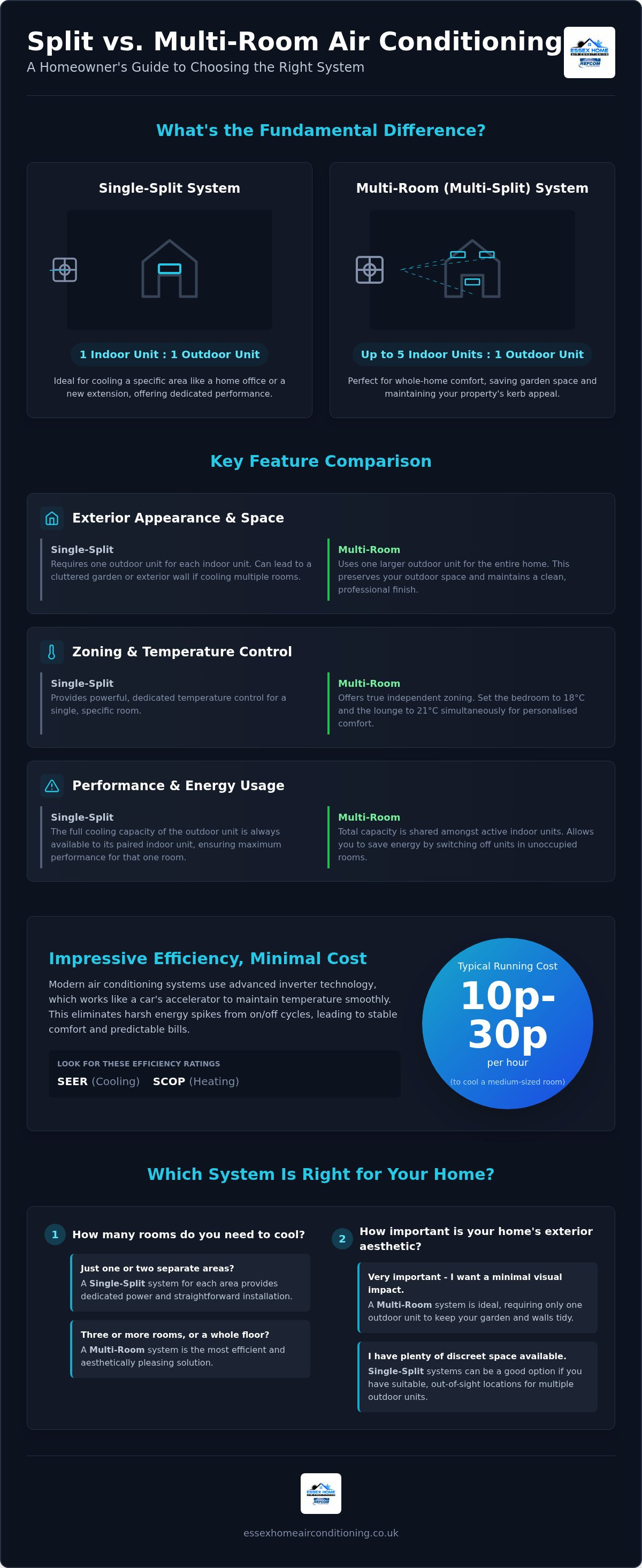
A single-split system operates on a straightforward 1:1 ratio. One indoor unit is hardwired and piped directly to one dedicated outdoor condenser. This setup ensures that the indoor unit has access to the full cooling capacity of the outdoor unit at all times. It's a great choice for cooling a specific area, such as a new kitchen extension or a dedicated home office in the garden. Because there is only one set of pipes to run, these installations are typically the quickest to complete and offer a very tidy, discreet finish on your exterior walls.
How Multi-Room Air Conditioning Operates
Multi-room air conditioning, often called a multi-split, uses a "hub and spoke" model. Here, a single, larger outdoor condenser can power up to five separate indoor units across different rooms. This is a brilliant solution for whole-home comfort without cluttering your property with five separate outdoor boxes. Each room operates as an independent zone, giving you several advantages:
Personalised Comfort: Set the master bedroom to a crisp 18°C whilst keeping the lounge at a milder 21°C.
Energy Savings: Turn off units in unoccupied rooms to save on electricity.
Tidy Exterior: One outdoor unit preserves your garden space and kerb appeal.
It's vital to understand capacity limits. The outdoor unit has a total "power budget". If you have five units running at full blast simultaneously, the system shares that total capacity amongst them. We design these bespoke setups to ensure the outdoor unit is sized correctly for your specific Essex property layout, balancing performance with energy efficiency. Choosing between split vs multi-room air conditioning ultimately depends on how many rooms you need to cool and the available space on your exterior walls.
Comparing Performance: Energy Efficiency and Control
Performance in the split vs multi-room air conditioning debate often boils down to how much you'll pay the energy supplier each month. Modern systems rely on inverter technology to keep these costs manageable. Unlike older units that simply click on and off at full power, an inverter works like a car's accelerator. It slows down or speeds up the motor to maintain a steady temperature. This prevents the heavy energy spikes that occur when a system has to work from a cold start, keeping your environment stable and your bills predictable.
To understand the long-term value, you should look at the SEER (Seasonal Energy Efficiency Ratio) and SCOP (Seasonal Coefficient of Performance) ratings. These numbers tell you how much cooling or heating you get for every kilowatt of electricity used. High-efficiency ENERGY STAR certified air conditioners and their UK-compliant counterparts are designed to minimise waste. In a typical Essex home, running a modern inverter system to cool a medium-sized room costs approximately 10p to 30p per hour, which is a small price for total comfort during a humid July afternoon.
Zoning and Individual Room Comfort
Multi-room systems offer genuine independence for every member of the household. You don't have to settle for a "one size fits all" temperature. Each indoor unit has its own thermostat and remote control, allowing you to prioritise the master bedroom for a crisp night's sleep whilst keeping the lounge at a milder setting. Most modern units we install now feature Wi-Fi integration. This allows you to organise your home's climate via a smartphone app, ensuring the house is perfectly chilled by the time you drive back to Basildon or Southend.
Efficiency Myths Debunked
There is a common myth that one large multi-split unit is always cheaper to run than three separate single-split units. This isn't strictly true. If you only spend your day in a home office and only turn on that one unit, a single-split system can be more efficient because the outdoor condenser is perfectly matched to that one room's load. Multi-split systems can also lose a small amount of efficiency through very long pipe runs if the indoor units are situated far away from the outdoor hub. Coefficient of Performance is a specific calculation that measures the ratio of heating or cooling provided compared to the electricity consumed.
Selecting the most efficient setup depends entirely on your daily habits and which rooms you use the most. If you want to ensure your system is sized correctly for your specific property layout, you can request a bespoke assessment from our local specialists.
Installation Considerations for Essex Properties
Essex homes vary from Victorian terraces in Chelmsford to modern detached houses in Basildon. Each requires a different approach to installation. When you're weighing up split vs multi-room air conditioning, the visual impact on your property is a major factor. Nobody wants their home to look like a commercial server room with a "wall of boxes" fixed to the brickwork. A multi-room system keeps things tidy by using a single outdoor condenser to power several indoor units, preserving your kerb appeal and garden space.
Planning permission is usually not required for standard residential air conditioning in Essex as it falls under Permitted Development. However, if you live in a conservation area, a flat, or a listed building, the rules are much stricter. Installing three or four separate single-split units might draw more attention from local planners or neighbours than one discreetly placed multi-split unit. It's always best to check with your local council if you're unsure, especially in historic parts of Colchester or Maldon.
Space Constraints and Outdoor Placement
Urban gardens in towns like Southend are often compact. Finding room for multiple outdoor units can be a puzzle that eats into your outdoor living area. A multi-room setup is a genuine space-saver. It requires only one firm, level base or a single set of wall brackets. Noise is another vital consideration. We take care to position the outdoor unit away from your neighbour's bedroom window or your own patio area to ensure quiet, undisruptive operation throughout the summer.
Pipework and Internal Routing
The complexity of an installation often comes down to how the pipes are routed. For a loft conversion, we might run pipework through the eaves or a storage cupboard to keep it out of sight. In a bungalow, we can often utilise the loft space for a completely hidden finish. Whilst multi-split systems involve longer pipe runs, professional home cooling system design ensures these are tucked away behind discreet trunking or within floor voids. We pride ourselves on a neat, tidy finish that respects your interior décor and leaves the site exactly as we found it.
Cost Analysis and Long-Term Reliability
Deciding between split vs multi-room air conditioning involves looking beyond the initial price tag of the units. You have to consider the balance between equipment costs and the labour required for a tidy, compliant installation. Whilst a single-split system is often the most affordable entry point for a single room, the financial picture changes as you add more zones to your Essex home. We believe in total transparency when it comes to these figures, ensuring you understand exactly where your investment is going.
Every installation we carry out must be performed by an F-Gas certified engineer. This isn't just a recommendation; it's a legal requirement that protects your warranty and ensures the refrigerant is handled safely. A professional installation also guarantees that your system operates at its peak efficiency, which is vital for keeping those 10p to 30p hourly running costs from creeping upwards over time.
Initial Purchase vs. Installation Labour
Multi-split outdoor units are complex pieces of engineering. They contain sophisticated valving and electronics to distribute cooling to different rooms, which makes them more expensive to buy than a standard single-split condenser. The labour costs also tend to be higher for multi-room setups. Routing pipework from one central hub to four different bedrooms takes significantly more time and precision than a simple "back-to-back" install where the units sit on opposite sides of the same wall. For a detailed breakdown of these variables, you can consult our multi room air conditioning cost Essex price guide.
Reliability and Redundancy
One factor often overlooked in the split vs multi-room air conditioning debate is the "single point of failure" risk. If you have one large outdoor unit powering your entire home and it develops a fault, every room loses its cooling at once. Choosing multiple single-split units provides a level of redundancy. If the unit in the lounge requires a repair, the systems in the bedrooms will continue to function perfectly.
You can mitigate these risks and extend the life of your equipment through regular air conditioning servicing Essex homeowners rely on. In a domestic setting, both architectures typically last 12 to 15 years if they are kept clean and well-maintained. We recommend an annual check-up to ensure your system remains leak-free and energy-efficient. If you're ready to find the most reliable setup for your specific property, contact our local team for a no-nonsense quote.
Decision Framework: Which System Should You Choose?
Picking between split vs multi-room air conditioning doesn't have to be a headache. It's a matter of logic and looking at the physical reality of your property. You'll want a system that works for your family's daily habits without turning your garden into a mechanical yard. We suggest a methodical approach to ensure you get a setup that is both compliant and comfortable.
Follow these four steps to narrow down your options:
Step 1: Count your rooms. Identify which spaces actually need cooling. You might find that only the upstairs bedrooms and a home office require climate control, whilst the downstairs stays naturally cool.
Step 2: Check your boundaries. Consider your neighbours and the proximity of their windows. A single, quiet multi-split unit is often more considerate than several smaller units running at once.
Step 3: Think about the future. Planning a loft conversion or a summer house soon? It's often more efficient to install a multi-room hub now that can accommodate those extra units later.
Step 4: Get expert eyes on the job. Consulting a residential air conditioning specialist Essex homeowners can rely on will prevent installation errors and ensure your system is perfectly sized for your layout.
When to Choose a Single-Split System
A single-split system is the most straightforward solution for targeted cooling. It's the perfect fit for a single-room extension or for providing quiet air conditioning for home offices. If you're working with a tighter upfront budget and only need one specific room chilled, this 1:1 ratio is your best bet. These systems are also easier to maintain individually, making them a practical choice for detached houses where outdoor space isn't a primary concern.
When Multi-Room is the Superior Choice
Multi-room systems are the go-to for comprehensive, whole-house comfort. They are specifically designed for larger Essex properties where aesthetics and kerb appeal are high priorities. By using one central outdoor unit, you avoid cluttering your walls with multiple condensers. This bespoke design ensures that every bedroom or living space receives the exact amount of cooling it needs, rather than a generic "one size fits all" blast. It's a tidy, disciplined way to manage your home's climate whilst keeping your exterior looking professional and neat.
Choose the Best Cooling Setup for Your Home
Deciding on split vs multi-room air conditioning ultimately comes down to your specific property layout and your cooling priorities. If you only need to chill a single home office or a new extension, a single-split system offers a simple and cost-effective solution. For those seeking whole-house comfort without cluttering their external walls with multiple units, a bespoke multi-room setup provides a tidy and energy-efficient alternative. Both options ensure independent temperature control, allowing every family member to stay comfortable whilst keeping energy bills under control.
We take pride in delivering neat, professional installations that respect your home's interior and exterior. With over 20 years of trade experience, our team ensures every fitting is fully F-Gas certified and compliant with the latest safety standards. We specialise exclusively in domestic properties, so you can trust us to handle your project with the care and precision it deserves. Ready to cool your home? Get a bespoke quote from your local Essex specialists today and take the first step toward a more comfortable living environment.
Frequently Asked Questions
Is it cheaper to have one multi-split or two single-split air conditioners?
The upfront price for two single-split units is often lower than a single multi-split condenser. However, when comparing split vs multi-room air conditioning, you must account for the labour involved in routing pipework. A multi-split setup requires more complex internal work to connect various rooms to one central hub. Whilst the equipment might cost more, you save on outdoor wall space and only need to maintain one condenser in the future.
Can I add more indoor units to a multi-split system later?
You can only add extra units if the outdoor condenser was originally installed with spare capacity and additional connection ports. If we install a three-port unit but only connect two rooms, you can easily add a third unit later. If the condenser is already at its limit, you would need to replace it or install a separate single-split system. We always recommend discussing your future plans, such as loft conversions, during our initial survey.
Do multi-room air conditioning systems use more electricity?
Modern multi-room systems are highly efficient because they use inverter technology to adjust power based on demand. They don't use more electricity than multiple single units when cooling the same area. In fact, if you only cool one room at a time, the system draws very little power. However, running units in four rooms simultaneously will naturally consume more energy than cooling a single home office or bedroom in your Essex property.
What happens if the outdoor unit of my multi-split system breaks down?
A multi-split system has a single point of failure; if the outdoor condenser stops working, every indoor unit connected to it will also stop. This is a key consideration when choosing between split vs multi-room air conditioning. Whilst modern units from reputable brands are extremely reliable, homeowners who prioritise redundancy often choose separate single-split units. Regular servicing helps prevent these total system outages and keeps your home comfortable year-round.
Can I mix different types of indoor units on a multi-split?
Yes, you can mix and match different styles of indoor units to suit the décor and layout of each room. You might choose a sleek wall-mounted unit for your bedroom in Basildon and a low-profile floor-standing unit for a conservatory or extension. As long as the units are compatible with the central outdoor condenser, the system will function perfectly. This flexibility allows for a truly bespoke home cooling design for your property.
Do I need planning permission for air conditioning in Essex?
Most residential installations in Essex fall under Permitted Development and do not require formal planning permission. However, restrictions often apply to flats, maisonettes, and listed buildings. If your property is in a conservation area in Chelmsford or Colchester, you should check with the local council first. We ensure every installation is tidy and discreet, which helps minimise any visual impact on your property or your neighbours' view.
How long does it take to install a multi-room air conditioning system?
A standard multi-room installation typically takes between one and three days to complete. The exact duration depends on the number of indoor units and the complexity of the pipe routing through your home. A simple back-to-back single-split install can be finished in a few hours, whilst hiding pipes in floor voids or lofts for a four-room setup takes longer. We always provide a clear, no-nonsense timeline before starting any work on your home.
Will a multi-room system provide independent temperature control in every room?
Every indoor unit in a multi-room setup operates with its own independent thermostat and remote control. This means your teenager can keep their bedroom at a crisp 18°C whilst you enjoy a milder 21°C in the lounge. You can also turn off units in unoccupied rooms to save energy. This zoning capability is one of the primary reasons Essex homeowners choose multi-split systems for their domestic properties to ensure everyone stays comfortable.


Comments