


Average Home Air Con Costs in Leigh-on-Sea 2026
There isn’t one figure that tells every household what air conditioning will add to its electricity bill. The average electricity cost of home ac Leigh-on-Sea households face depends on their electricity tariff, how long they run the system and the rooms they want to cool. A figure based on another home may not reflect your insulation, glazing or daily routine.
A more useful estimate starts with your own tariff and likely hours of use. This guide explains how to calculate one, which details affect the result and why a system’s cooling capacity is not the same as the electricity it uses. You’ll also find practical points to consider when choosing home cooling in Leigh-on-Sea.
Modern split air conditioning can provide heating as well as cooling. Whether you’re considering a bedroom, home office or several rooms, the right system depends on your home and how you want to use it. We also compare split systems with portable units so you can weigh up how each option works in practice.
Table of Contents
What affects the average electricity cost of home AC in Leigh-on-Sea?
The average electricity cost of home ac Leigh-on-Sea homeowners see online may not reflect their own bill. Electricity consumption is the amount a system uses, while the bill impact depends on that use and your household tariff. A kilowatt-hour (kWh) measures electricity used over time. To estimate the cost, multiply the system’s electricity use in kWh by the rate on your tariff.
Your estimate depends on the system’s electrical input, how long it operates and your household tariff. Those details make a generic average a poor guide to what you’ll pay. For a plain-English overview of how systems work and the factors that affect efficiency, see Air conditioning.
Why two homes in Leigh-on-Sea can have different bills
Room volume, glazing, insulation and orientation affect how much heat enters a room and how hard the system may need to work. Occupancy and other sources of heat matter too. For example, a sun-facing room with substantial glazing can have different cooling needs from a shaded, well-insulated bedroom, even if their floor areas are similar.
Weather, thermostat settings and which rooms you use all influence operating patterns. You might cool a bedroom in the evening and use a home office during the day. Running the system for longer or choosing a lower set temperature can change consumption, so your routine matters as well as the equipment.
What an electricity cost estimate can and cannot tell you
An estimate helps you compare possible usage patterns, but it isn’t a guaranteed bill. It is based on the input, running hours and tariff used in the calculation. If one of those changes, the result changes too. If your tariff has different rates at different times, use the rate that applies when you expect to run the system.
Use the result as a guide, not a promise. A room-by-room assessment can help match the system design to your home and the spaces you want to cool.
How to estimate home AC electricity use without relying on a generic average
For a useful estimate, start with the air conditioner’s stated electrical input, the hours you expect to run it and the electricity tariff on your bill. An online average may use assumptions that don’t fit your system or routine. Your own figures are a more relevant starting point.
Which details do you need for a useful estimate?
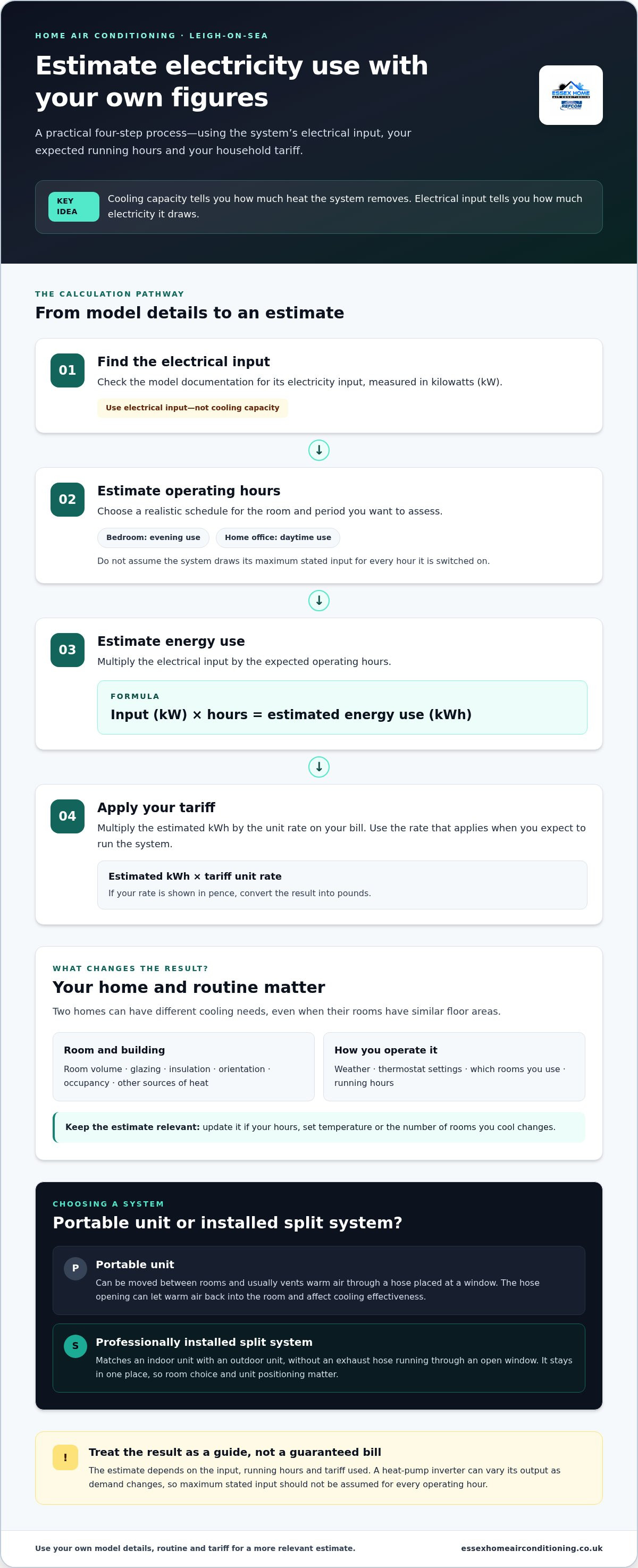
Check the model documentation for its electrical input, then estimate a realistic schedule for the room. A bedroom used in the evening has a different pattern from a home office used during the day. Don’t assume the system uses its maximum stated input for every hour it’s switched on.
Find the electrical input in the model’s documentation. Use the electricity input figure, not the cooling capacity.
Estimate operating hours for the room and period you want to assess.
Calculate energy use by multiplying the input in kilowatts by the operating hours. The result is an estimate in kilowatt-hours (kWh).
Apply your tariff by multiplying the estimated kWh by the unit rate on your bill. If the rate is in pence, convert the result into pounds.
Use the tariff rate that applies at the times you expect to run the system. For broader UK energy supply, demand and consumption context, the government’s UK Energy Trends collection provides quarterly statistics. Your own bill is the relevant source for your tariff.
Why the system’s stated capacity is not your bill
Cooling capacity describes the heat removed from a room; electrical input describes electricity drawn from the supply. They’re related, but they aren’t interchangeable. A heat-pump inverter can vary its output as demand changes, so don’t assume it draws its maximum stated input throughout every operating hour. To discuss room-specific system design, explore home air conditioning installation.
Which home AC choices can change electricity use in Leigh-on-Sea?
Your choice of system affects how it is installed and used, but electricity consumption still depends on the room, equipment and household routine. A portable unit and a professionally installed split system work differently, so compare them against the space you want to cool and how often you’ll use it.
Portable unit or split system: what changes for the household?
For more detail on the installed option, read the wall-mounted air conditioning guide. Potential efficiency doesn’t guarantee savings. Actual use depends on the system, your home and how you operate it.
How operating habits affect your estimate
Update your estimate if your routine changes. Longer running hours, a lower set temperature or cooling additional rooms can all affect electricity use. For a more controlled pattern, cool the rooms you occupy and choose a comfortable, sensible set temperature rather than aiming for excessive cooling.
A cool the fabric strategy, which means pre-cooling the building during lower-tariff periods, may suit some households. It isn’t a guaranteed saving; its value depends on your tariff, home and schedule. For a system designed around the rooms you use in Leigh-on-Sea, get in touch with Essex Home Air Conditioning.
Leigh-on-Sea Air Con: Choosing for Electricity Use
A sensible system choice starts with the rooms you want to use comfortably, not a promise about a particular bill. For a home in Leigh-on-Sea, room-by-room design should account for room volume, glazing, insulation, orientation, occupancy and heat load. A conservatory, bedroom and home office can each place different demands on a system.
Modern split air conditioning can provide heating as well as cooling, which may suit households looking for year-round comfort from one system. Essex Home Air Conditioning installs residential systems in Leigh-on-Sea, from wall-mounted units to multi-room designs. Oliver brings over 20 years of trade experience to home installations and servicing.
What a tailored system discussion should cover
Start with the rooms you want to condition, when they’re occupied and how you expect to use the system. Indoor and outdoor unit positions matter too: they affect how the installation fits your home, the airflow and the sound you may notice. Discussing pipework routes and a tidy finish helps plan an installation that sits neatly within the property.
System sizing based on room volume means considering the room’s three-dimensional space, not just its floor area. Glazing, insulation, orientation, occupancy and heat load all help shape the design. The Essex home air conditioning installation guide explains what an installation involves.
A practical next step for Leigh-on-Sea homeowners
For a useful quotation, share the rooms you want to condition, relevant property details and your likely operating pattern. Essex Home Air Conditioning is F-Gas REFCOM registered, supporting compliant installation of systems that contain refrigerant. A tailored discussion can help set clear expectations for the proposed system without promising a particular electricity bill, and you can easily get in touch to discuss your home air conditioning requirements.
Plan home cooling around your rooms and routine
There isn’t one dependable figure for the average electricity cost of home ac Leigh-on-Sea homeowners can expect. A useful estimate starts with the system’s electrical input, the hours you expect to use it and your electricity tariff. Room conditions and daily habits also shape consumption, so treat the result as a guide rather than a promise.
Choosing well means looking beyond floor area. Room volume, glazing, insulation, orientation, occupancy and heat load all help inform system design. A modern split system can provide heating as well as cooling, giving you another option for comfort through the year.
Essex Home Air Conditioning installs and services residential systems in Leigh-on-Sea and across Essex, including Basildon, Benfleet, Rayleigh, Canvey Island, Wickford, Billericay, Brentwood, Southend, Maldon, Chelmsford, Burnham and Grays. Oliver has over 20 years of trade experience. A tailored discussion can help you consider options for the rooms you want to condition and how you plan to use them.
Frequently Asked Questions
How much electricity does home air conditioning use in Leigh-on-Sea?
Electricity use depends on the unit’s stated electrical input, its operating hours, the rooms being cooled and your household tariff. There’s no single average electricity cost of home ac Leigh-on-Sea households can rely on because equipment and electricity plans differ. Check the model documentation, estimate when you’ll run the system, then apply your tariff instead of borrowing a generic figure.
Does a split air conditioning system cost less to run than a portable unit?
There’s no fixed result that applies to every home. A portable unit’s exhaust hose can let warm air back into the room, affecting how effectively it cools. Compare each option’s stated electrical input and likely operating pattern, then estimate use for the room you want to keep comfortable.
Can home air conditioning also heat a room?
Yes. Modern split air conditioning can provide heating as well as cooling through an air-to-air heat pump. Whether it suits your home depends on the property, rooms and heating needs, so include expected seasonal use when considering system design and electricity consumption. Essex Home Air Conditioning installs residential heating and cooling systems in Leigh-on-Sea and across Essex, including Basildon, Benfleet, Rayleigh, Canvey Island, Wickford, Billericay, Brentwood, Southend, Maldon, Chelmsford, Burnham and Grays.
How can I estimate the electricity cost of running home AC?
Multiply the unit’s stated electrical input in kilowatts by expected operating hours to estimate use in kilowatt-hours, then apply the unit rate on your electricity bill. Use the rate that applies when you’ll run the system. This gives you a more relevant estimate than a generic average, although actual consumption can vary with room conditions and demand. Cooling capacity describes heat removed, not electricity drawn.
Does the size of a room determine how much electricity its air conditioner uses?
Room size affects cooling demand, but floor area alone can’t determine the right system or its electricity use. System sizing based on room volume considers the three-dimensional space alongside glazing, insulation, orientation, occupancy and heat load. For example, a sunny conservatory and a shaded bedroom of similar size can place different demands on their systems.

Comments