


Cooling a Hot Kitchen in Southend: The Complete Homeowner Guide

Cooking dinner while the afternoon sun streams through south-facing bifold doors quickly turns a kitchen into a sweltering greenhouse. Between roasting ovens, boiling hobs, and unshaded glazing, standard extractor fans simply cannot keep up. Temporary portable units only add deafening noise while letting warm draughts straight back inside. When you need reliable cooling a hot kitchen Southend properties demand a permanent, properly calculated setup that manages both appliance heat and intense summer sun.
You shouldn't have to dread preparing meals on warm summer days. Discover how to cool your hot Southend kitchen efficiently using tailored residential air conditioning solutions that keep your living space quietly comfortable from morning to evening. In this guide, we explain how fixed air-to-air heat pumps manage heavy heat loads, how strategic unit placement protects internal coils from cooking grease, and what local Southend planning rules mean for your home.
Table of Contents
Why Modern Southend Kitchens Suffer from Severe Summer Heat
Home extensions across Southend have transformed how we live, turning cramped cookspaces into bright, open-plan kitchen-diners. Yet these contemporary layouts face a major design challenge: they trap heat remarkably well. When coastal Essex experiences long, sunny summer days, a modern extension quickly becomes uncomfortably hot. Achieving effective cooling a hot kitchen Southend homeowners discover, involves tackling two separate heat sources simultaneously: direct solar gain and internal cooking appliances.
The Impact of Bifold Doors and Glazed Extensions
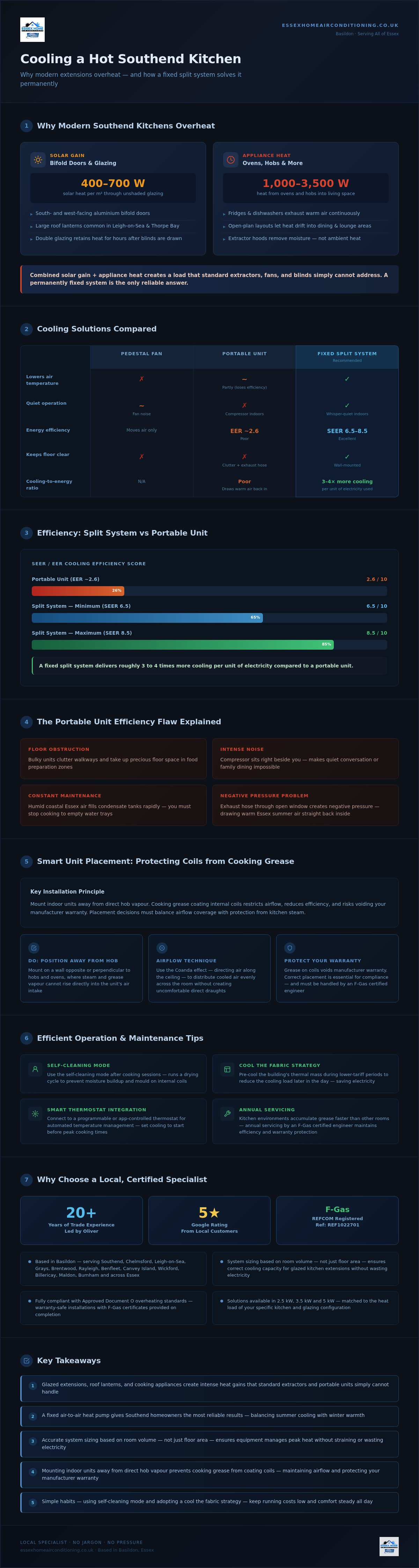
Expansive glass is a staple of properties in Leigh-on-Sea, Thorpe Bay, and central Southend. However, unshaded south- or west-facing aluminium bifold doors and large roof lanterns act like commercial glasshouses. Peak summer sunlight passes freely through the glazing, transferring between 400 W and 700 W of solar heat per square metre directly into the room. High-performance building insulation and double glazing are engineered to retain winter warmth; in July and August, they trap that heat inside for hours, long after internal blinds are drawn.
Internal Heat Gains from Modern Domestic Appliances
Cooking introduces immediate, concentrated thermal energy. Routine meal preparation creates substantial internal heat gains:
Ovens and Hobs: Emitting between 1,000 W and 3,500 W of combined sensible and latent heat directly into the living space.
Refrigeration and Dishwashers: Running compressors and drying cycles that continuously exhaust warm air into the room.
Open-Plan Layouts: Allowing heat and steam to drift unrestrained into adjacent dining, lounge, and homework areas.
Many homeowners assume an extractor hood will solve the problem. It won't. Standard hoods follow fundamental kitchen ventilation principles, meaning they are designed to capture airborne grease, steam, and food odours. They pull moisture outside, but they do not alter ambient air temperature or chill incoming air. When oven heat meets afternoon glazing loads, cooking a hot kitchen Southend families want to enjoy becomes an ordeal, turning an evening meal into an exhausting chore.
Comparing Kitchen Cooling Solutions: Fans vs Portables vs Split Systems
When summer cooking turns an extension into a hot box, most homeowners try quick fixes before seeking a permanent answer. Pedestal and tower fans are usually the first attempt. While they move air across your skin to create a brief breeze, they cannot lower the actual air temperature. They simply stir hot cooking air around the room. For real thermal comfort and dependable cooling a hot kitchen Southend households need a system that physically extracts heat and rejects it outside.
The Severe Limitations of Portable Air Conditioning
Buying a mobile unit from a retail store seems tempting, but it quickly reveals the classic portable unit efficiency flaw. These units require an exhaust hose wedged through an open window or door. That opening creates negative air pressure, drawing warm Essex summer air straight back into the kitchen. On top of that, you face practical daily headaches:
Floor Obstruction: Bulky units clutter walkways and take up precious floor space in food preparation zones.
Intense Noise: Having the compressor right beside you makes quiet conversation or family dining impossible.
Constant Maintenance: Humid coastal air fills internal condensate tanks rapidly, forcing you to stop cooking to empty water trays.
Poor Efficiency: Most portables struggle around an Energy Efficiency Ratio (EER) of 2.6, working flat out while barely lowering room temperatures.
Why a Wall-Mounted Split System Outperforms All Alternatives
A permanently installed air-to-air heat pump completely separates the cooling process from the living space. The noisy mechanical work happens outside, connected via sealed refrigerant pipework. Inside, an unobtrusive wall-mounted unit delivers smooth, whisper-quiet climate control. By following statutory Approved Document O standards on overheating, modern split systems provide genuine energy efficient home cooling designed to counteract extreme glazing and cooking loads.
With high SEER rating performance between 6.5 and 8.5, an inverter system returns roughly three to four times more cooling energy than the electricity it draws. Better still, these units are fully reversible. On crisp winter mornings in Southend, the same system provides rapid, low-carbon heating before the central radiators even warm up. If you want to explore permanent options for your home, you can request advice from our local team to find the right configuration for your room layout.
How to Plan Your Kitchen Air Conditioning Installation in Southend
A successful kitchen retrofit requires proper survey work before tools ever leave the van. Following standard GOV.UK keep cool at home guidance helps reduce excess heat sources, but permanent climate control demands a structured engineering plan. When planning reliable cooling a hot kitchen Southend homes benefit most from five practical steps: surveying total volume, calculating combined thermal loads, checking electrical consumer unit capacity, selecting an unobtrusive outdoor location, and ensuring full regulatory sign-off.
Calculating Heat Loads and Split-System Capacity
Never rely on basic floor area estimates. Proper design requires system sizing based on room volume, factoring in ceiling heights, large roof lanterns, and wall construction. Sizing calculations must balance cooking heat with solar exposure, matching the space to a 2.5kW, 3.5kW, or 5kW split-system capacity. An integrated heat-pump inverter smoothly modulates motor speed to meet cooling demand without continuous stop-start cycling, preventing high electricity spikes while holding temperatures rock steady.
Outdoor Condenser Siting for Southend Properties
The external unit needs unrestricted airflow away from direct foliage. In suburban Southend avenues and coastal roads, sensible placement ensures peace of mind:
Mounting Foundations: Heavy-duty rubber anti-vibration mounts isolate mechanical motion from brickwork, eliminating low-frequency hum.
Permitted Development: Under Class G rules, domestic heat pumps rarely require full planning permission, provided outdoor noise levels stay at or below 42 dB(A) under the MCS 020a standard.
Local Planning Nuances: Southend conservation areas, such as Leigh Old Town or Clifftown, restrict highway-facing external units, while listed properties always require formal listed building consent.
Ensuring F-Gas Compliance and Warranty Security
Connecting high-pressure refrigerant pipework is not a standard DIY or handyman task. By law, only a qualified F-Gas certified engineer can handle refrigerants, pressure-test lines, and sign off the installation. You can read more about building standards in our complete guide to air conditioning installation in Essex. Proper commissioning through an accredited installer ensures a valid certificate of compliance, protects your home's electrical safety, and safeguards your full manufacturer warranty for years to come.
Indoor Unit Placement: Managing Airflow, Cooking Fumes, and Aesthetics
Positioning an air conditioning unit inside a kitchen is completely different from fitting one in a bedroom or home office. Cooking creates airborne grease particles, aerosolised fats, and bursts of high-humidity steam. If you place an indoor unit incorrectly, it will draw those contaminants directly into its internal components. Getting your layout right guarantees effective cooling a hot kitchen Southend properties require, without compromising hygiene or ruining your interior design.
Protecting Internal Coils from Kitchen Grease
An indoor unit must never sit directly above a hob, cooker hood, or oven stack. When hot oil vapour hits cold aluminium heat exchanger fins, it condenses into a sticky film. Over time, that layer clogs the delicate fin spacing, binds dust, causes lingering smells, and can invalidate your manufacturer warranty. By mounting the indoor unit several metres away in an adjoining dining or seating zone, airborne grease drops out of circulation before reaching the air intake. Removable, washable mesh filters catch any remaining airborne dust and simply rinse clean under a tap every few weeks.
Optimising Air Distribution Across Dining Areas
Nobody wants freezing air blowing straight onto their roast dinner. Smart indoor unit placement takes advantage of the Coanda effect, skimming cool air gently across the ceiling rather than blasting downwards. This technique mixes the chilled air smoothly with existing warm air, establishing an even temperature across the entire room. Motorised 3D louvres sweep the airflow horizontally and vertically, clearing stubborn warm spots gathered beneath roof lanterns and around glazed bifold tracks.
Achieving a Discreet, Tidy Finish
Modern kitchens represent significant financial investments; visible surface trunking or messy dangling pipes are out of the question. Professional installers focus on delivering a tidy finish that protects your room's aesthetic:
Concealed Services: Refrigerant lines, interconnecting cables, and drain lines are routed cleanly behind kitchen units, within stud walls, or straight out through the rear external brickwork.
Condensate Management: Water extracted from humid kitchen air drains via gravity where possible, or through a silent mini-pump tucked neatly out of sight.
Sleek Profiles: As detailed in our overview of wall mounted air conditioning for homes, contemporary indoor casings come in matt white, silver, or dark graphite finishes to match high-end cabinetry.
If you want help planning the ideal position for an indoor unit in your home, contact our local team to book a tidy, compliant kitchen survey.
Efficient Operation and Maintenance for Kitchen Air Conditioning
Operating a fixed split system properly keeps electricity bills modest while maintaining steady indoor comfort. For dependable cooling a hot kitchen Southend households do not need to blast their equipment on maximum power. Simple operating routines reduce electrical consumption and keep internal components spotless for years to come.
Smart Operation Strategies to Minimise Running Costs
Modern inverter compressors run most efficiently when maintaining a constant setpoint between 21°C and 23°C. Avoid turning the system off entirely during hot weather only to switch it on as the oven heats up. Instead, adopt a cool the fabric strategy: pre-cool the kitchen early in the day, cooling the floor tiles, worktops, and masonry before peak afternoon solar gain strikes. By using smart thermostat integration, you can automate schedules via your phone, ensuring the room stays pleasantly cool before cooking starts. Check our practical guide on energy efficient home cooling to save on household electricity.
Essential Routine Care and Self-Cleaning Features
A cooking environment demands sensible hygiene habits to preserve optimal airflow and indoor air quality:
Run Internal Drying Cycles: Engage your system's self-cleaning mode after cooking. This runs a low-speed fan cycle that dries residual condensation on the evaporator coil, preventing trapped moisture, mould spores, and stale grease odours.
Rinse Filters Monthly: Pop open the front casing every two to four weeks, slide out the mesh filters, and wash them in warm soapy water to stop oily residue choking the intake.
Check Condenser Grilles: Take a quick look at your outdoor condenser once a month to ensure garden leaves, cobwebs, and coastal salt spray are kept clear of the heat exchanger fins.
Professional Servicing in Southend-on-Sea
While homeowners can easily manage filter rinsing, annual maintenance by a certified technician remains essential. During a visit, an engineer inspects refrigerant operating pressures, clears condensate drain lines with specialised wash solutions, and checks electrical terminal torque. Routine servicing keeps the equipment working at maximum thermodynamic efficiency and protects your ongoing manufacturer warranty. Learn more by reading our dedicated guide on air conditioning servicing Southend. Ready to make your open-plan extension comfortable again? Homeowners can request a free local kitchen cooling survey from our experienced team today.
Transform Your Southend Kitchen into a Cool, Usable Space All Summer
You don't have to put up with a stuffy, overheated kitchen every time you switch on the hob or host friends on a sunny afternoon. When tackling cooling a hot kitchen Southend homeowners achieve genuine, lasting relief by pairing a properly sized air-to-air heat pump with sensible indoor unit placement. That means an end to intrusive portable unit noise, no grease-clogged coils, and steady, energy-efficient comfort right through the warmest Essex heatwaves.
Backed by over 20 years of trade experience across Southend and Essex led by Oliver, our team treats your living space with the utmost care. Our REFCOM registered, F-Gas certified engineers (Ref: REF1022701) ensure every installation is fully compliant, protected by manufacturer warranties, and finished with the tidy workmanship reflected in our 5 Star Google Rating. Ready to enjoy cooking in comfort again? Book your free, no-obligation kitchen cooling survey with our Southend team today.
Frequently Asked Questions
Can I install air conditioning in a kitchen without ruining the decor?
Yes, modern wall-mounted units blend seamlessly into contemporary home kitchens. Installers achieve a tidy finish by routing pipework and electrical interconnects behind fitted cabinetry, through stud cavities, or directly through external brickwork. Casing finishes in matt white, silver, or dark graphite complement bespoke cupboards and modern work surfaces without visible trunking cluttering your walls.
Will cooking grease and oil vapour damage an indoor air conditioning unit?
Cooking grease will only cause problems if the indoor unit is positioned incorrectly directly over a hob. When solving cooling a hot kitchen Southend installers mount indoor units several metres away in dining or family areas. This distance allows heavy cooking oils to drop out of circulation, while washable mesh filters catch any remaining airborne particles before they touch internal coils.
How much does it cost to run a kitchen air conditioning system in the UK?
Modern inverter split systems deliver exceptional electrical efficiency, typically operating at high Seasonal Energy Efficiency Ratios. Instead of running on maximum power, the compressor modulates down to maintain your desired temperature once reached. Running costs depend on your energy tariff, room volume, and solar exposure, but efficient operation keeps everyday usage remarkably economical compared to central heating.
Can an air-to-air heat pump also heat my kitchen in winter?
Yes, all fixed split systems operate as fully reversible air-to-air heat pumps. In colder months, the refrigeration cycle reverses to extract thermal energy from outside air and deliver fast, low-carbon heating indoors. This provides an effective way to warm cold tiled kitchen floors and glazed extensions on chilly Essex mornings without needing your central heating boiler.
Do I need planning permission to install an external condenser in Southend?
Most residential installations fall under permitted development rights, meaning you do not need a formal planning application. The external condenser must comply with acoustic standards under MCS 020a, staying at or below 42 dB(A) at your neighbour's boundary. Properties in Southend conservation areas face highway-facing mounting restrictions, while listed buildings always require full listed building consent.
What size air conditioning unit is required for an open-plan kitchen diner?
Accurate system sizing based on room volume ensures you get the right capacity rather than guessing from floor area alone. Smaller kitchens often suit a 2.5kW unit, whereas large open-plan spaces with bifold doors and roof lanterns usually require a 3.5kW or 5kW split-system capacity. A professional survey balances total cubic space, glass exposure, and appliance wattage to match your exact room load.
How often do kitchen air conditioning filters need cleaning?
We recommend inspecting and rinsing kitchen filters every two to four weeks during heavy summer usage. In a cooking environment, airborne dust and steam build up faster than in bedrooms. The front panel unclips easily, letting you slide out the mesh screens, wash them in warm soapy water, and replace them once dry to maintain unrestricted airflow and efficient cooling.


Comments