Best wall-mounted air con for your lounge: a buying guide
A living room has a TV, a sofa and often a lot of sun, so it needs its own plan. Here is how to choose, size and place a wall-mounted unit that keeps the lounge comfortable all year.
The lounge is where most families spend their evenings, so it is often the first room people want to air condition. It is also where the wrong choice shows: a unit that hums over the TV, blows onto the sofa or struggles on a sunny afternoon soon becomes a nuisance.
This guide explains how a wall-mounted split system works, what makes a lounge different from other rooms, how to size it, and which features matter most in a living room. It also shows how our six fixed-price packages compare at the usual living room size.
The anatomy of a modern split system
A wall-mounted split system has two parts, joined by a pair of insulated copper pipes and a cable:
- The indoor unit sits high on the lounge wall. It draws in room air, passes it over a cold coil and blows it back out, with a filter to catch dust on the way in.
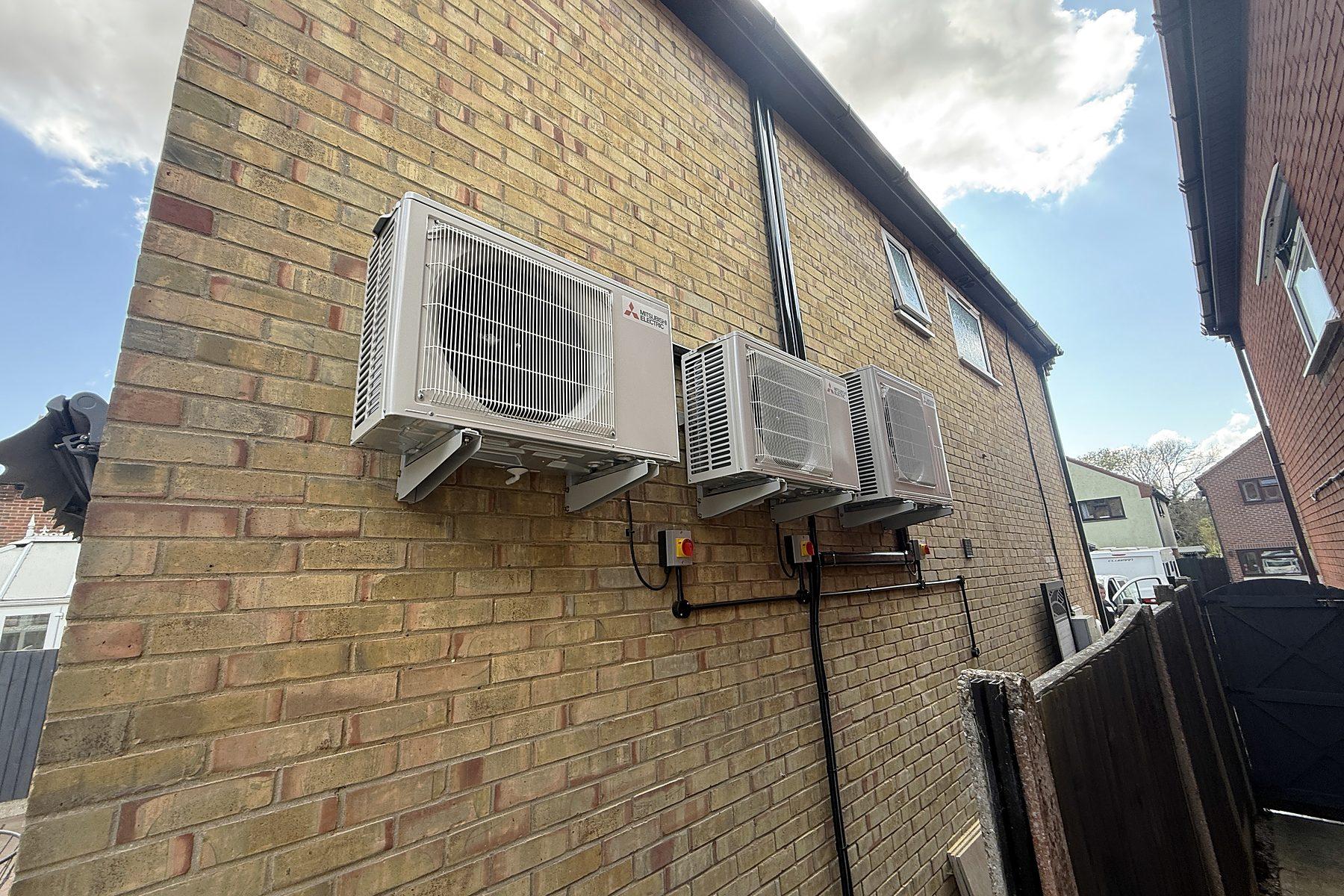
- The outdoor unit sits outside, usually on the back or side wall or on the ground. It holds the compressor and the larger fan.
An air conditioner does not make cold. It moves heat. A refrigerant carries heat out of your lounge and releases it outside. In winter the system runs the other way and brings heat in, which is why it can heat as well as cool.
Splitting the system keeps the loudest parts outside, which is why it is quieter than a portable unit. It also needs no hose through a window and takes up no floor space.
Modern units use an inverter: the compressor speeds up and slows down to hold the temperature you set, like a dimmer switch rather than an on/off switch. The result is a steadier room temperature.
Why lounges require a specific cooling strategy
A bedroom is mainly used at night. A lounge is used through the day and the evening, by more people, with more going on. That changes what matters:
- The TV. You will be sitting still and listening, so indoor noise matters more than in a hallway or kitchen.
- The sofa. People sit in the same spots for hours. A draught across those spots is the most common complaint about badly placed units.
- The sun. Many lounges have large windows, French doors or bi-folds. On a bright afternoon, sun through the glass can heat the room quickly.
- Year-round use. The lounge is where you sit on a cold evening too, so heating is just as useful as cooling.
A muggy summer day can feel worse than the thermometer suggests. Split systems remove moisture as they cool, and many have a dry mode that focuses on that, so the room can feel fresher without being made very cold.
If your lounge is part of an open-plan kitchen and dining space, the planning is different again. Our open-plan living air conditioning guide covers zoning and when two units work better than one.
How to size your unit
Capacity is shown in kilowatts (kW). It tells you how much heat the unit can move. Our size guide is based on floor area:
- Up to 25m²: 2.5kW (a standard bedroom)
- Up to 35m²: 3.5kW (a large bedroom or a standard living room)
- Up to 50m²: 5kW (a large living room or open space)
- Over 50m²: quoted on request
So most lounges are a 3.5kW job, and larger lounges or through-lounges are usually 5kW.
You may see older guides quote BTU instead. It is just a different unit for the same thing. 1kW is about 3,412 BTU/h, so a 3.5kW unit is roughly 11,940 BTU/h and a 5kW unit is roughly 17,060 BTU/h.
Floor area is only the starting point. Large south-facing windows, a high ceiling or a lot of glass can push a lounge up a size. Too small, and the unit runs flat out without getting there. Too big, and it can leave the room cold but clammy. Our guide on what size air conditioner you need explains this in more detail. We check the size at a free survey before you book.
Noise levels and silent modes
In a lounge, quiet running matters. Because the compressor is outside, what you hear indoors is mostly the fan moving air. That sound depends on the fan speed you choose.
- Quiet or night mode drops the fan to its lowest speed. Most units have one, and it is the setting to use while you watch TV.
- Cool the room first. Running the unit harder before you sit down, then turning it down, keeps the evening quieter.
- Check the spec sheet. Manufacturers publish indoor sound levels for each model and size, from the quietest setting to full fan speed.
As one example, Samsung publishes indoor noise of 16 to 38 dB(A) for the 3.5kW WindFree Comfort on our Bronze package, from the quietest setting to the fan on full. Figures differ by brand and size, so compare like with like. Our guide to how noisy air conditioning is sets out figures from manufacturer data sheets.
Smart features and home automation
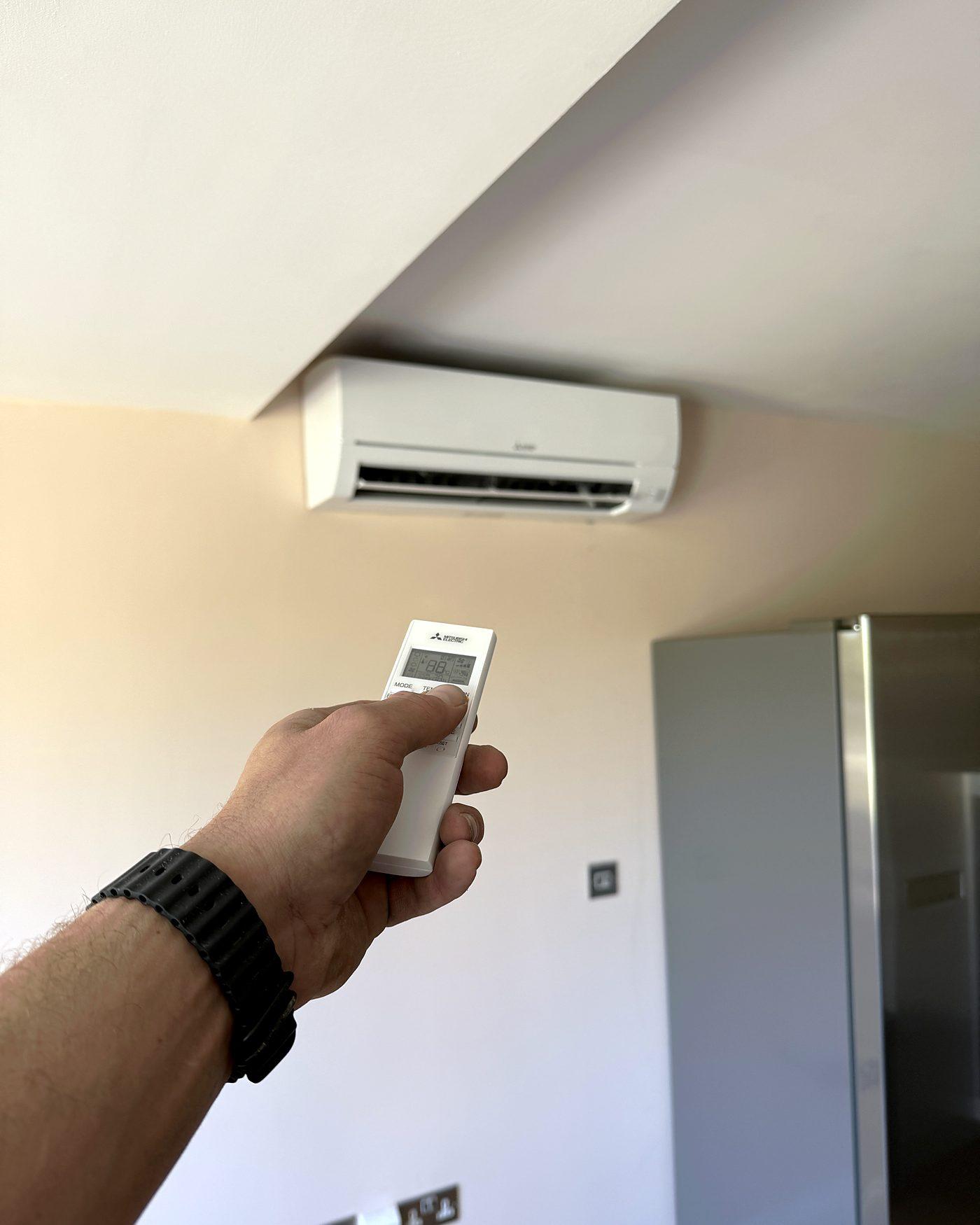
Most modern units come with a handheld remote, and many can also be controlled from a phone app, either built in or through an add-on adaptor, depending on the model. App control lets you:
- Turn the lounge on before you get home, so it is cool or warm when you walk in.
- Set timers and weekly schedules.
- Check that you switched it off after you left.
Some models also work with voice assistants. Features vary by model, so if app or voice control matters to you, tell us at survey and we will check.
Heating your lounge in winter
Every system we fit is an air-to-air heat pump, so it heats as well as cools. On a chilly spring or autumn evening, you can warm the room you are sitting in without heating the whole house. The same remote or app switches between the two.
Optimal placement for aesthetics and performance
Where the indoor unit goes makes as much difference as which unit you buy. We look at:
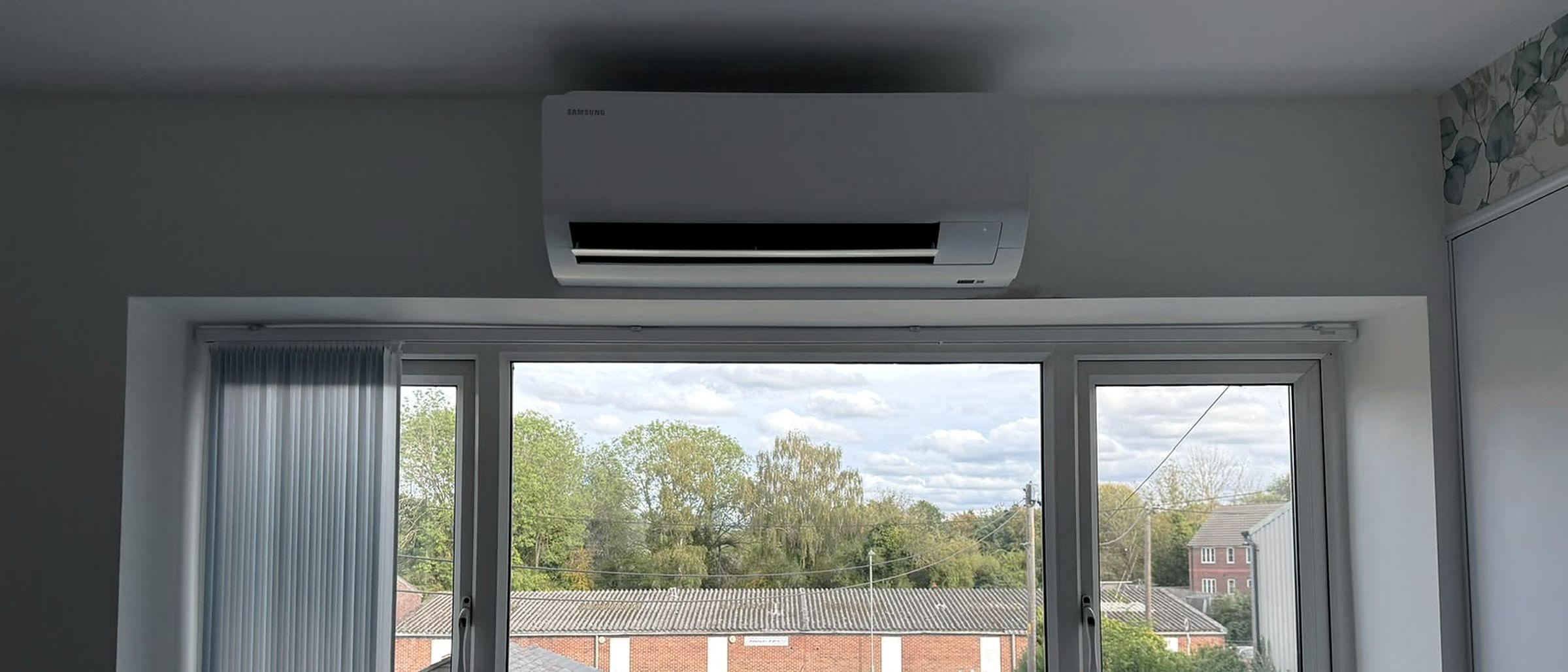
- Airflow across the room. The unit sits high on a wall so air can travel the length of the room and mix before it reaches you.
- Not over the sofa. We avoid aiming the main airflow straight at seating. Most units let you set the vertical and horizontal direction of the louvres to send air across the room instead.
- Out of direct sun. A unit in full sun can read the room as warmer than it is.
- A tidy pipe route. Ideally the pipes go straight through the wall behind the unit to the outdoor unit. Where they have to run on a surface, we use neat trunking.
- Drainage. The unit makes water as it cools. If it is not on or next to an outside wall, a condensate pump is needed, which adds £200.
- The outdoor unit. It needs a spot that is easy to reach for servicing and away from your patio and your neighbours' windows where possible.
Which package suits a living room?
Here are all six of our packages at 3.5kW, the size most lounges need:
| Package | System | Price (3.5kW) | Parts warranty |
|---|---|---|---|
| Budget | Haier Revive Plus | £1,605 | 3-year parts warranty |
| Bronze | Samsung WindFree Comfort | £1,870 | 7-year parts warranty |
| Silver | Fujitsu Standard KM White | £1,945 | 5-year parts warranty |
| Gold (recommended) | Mitsubishi Heavy Industries Premium ZS White | £2,185 | 10-year parts warranty |
| Platinum | Daikin Perfera White | £2,300 | 3-year parts warranty |
| Elite | Daikin Stylish White | £2,705 | 3-year parts warranty |
Prices are fully supplied, installed, tested and commissioned, including VAT. Living rooms tend to suit the middle and upper packages, because the room gets a lot of use and the unit is on show. Silver is a good value starting point, Gold is our recommended package with a 10-year parts warranty, and Platinum suits anyone who wants a premium finish. Budget, Bronze and Elite are there too. Bronze uses Samsung's WindFree mode, which spreads air through many small holes rather than one blast, so it is worth a look if draughts bother you. Our living room air conditioning page also shows 5kW prices for larger lounges, and the full price list covers every size and package.
The importance of F-Gas certification
The refrigerant inside an air conditioner is a fluorinated gas. In the UK, anyone installing or servicing air conditioning for someone else must be F-Gas certified. It is a legal requirement, not an optional extra. A certified engineer pressure-tests the pipework, removes air and moisture from the system, and commissions it so it runs as the manufacturer intended.
Keep your commissioning paperwork safe. It shows the system was installed properly, and it is useful for servicing and if you sell your home. Manufacturer warranty terms vary, so check the terms for your model. We are F-Gas REFCOM registered, number REF1022701, and our F-Gas registered installer guide explains how to check any installer.
Choosing a local Essex installer
We are based at Bowers Gifford, Basildon, and the team is led by Oliver, who has over 20 years of trade experience. We are NAPIT registered (64714) for the electrical side.
Every job starts with a free survey, where we confirm the size, the unit position and the pipe route. After installation we recommend a service once a year to keep the filters and coils clean and the system running well.
Get a fixed price for your lounge
Use our price tool to see your fixed price for your lounge at the right size, with all six packages side by side. If you have questions about your room, contact us or call 01268 264002, Monday to Friday, 08:00 to 17:00.
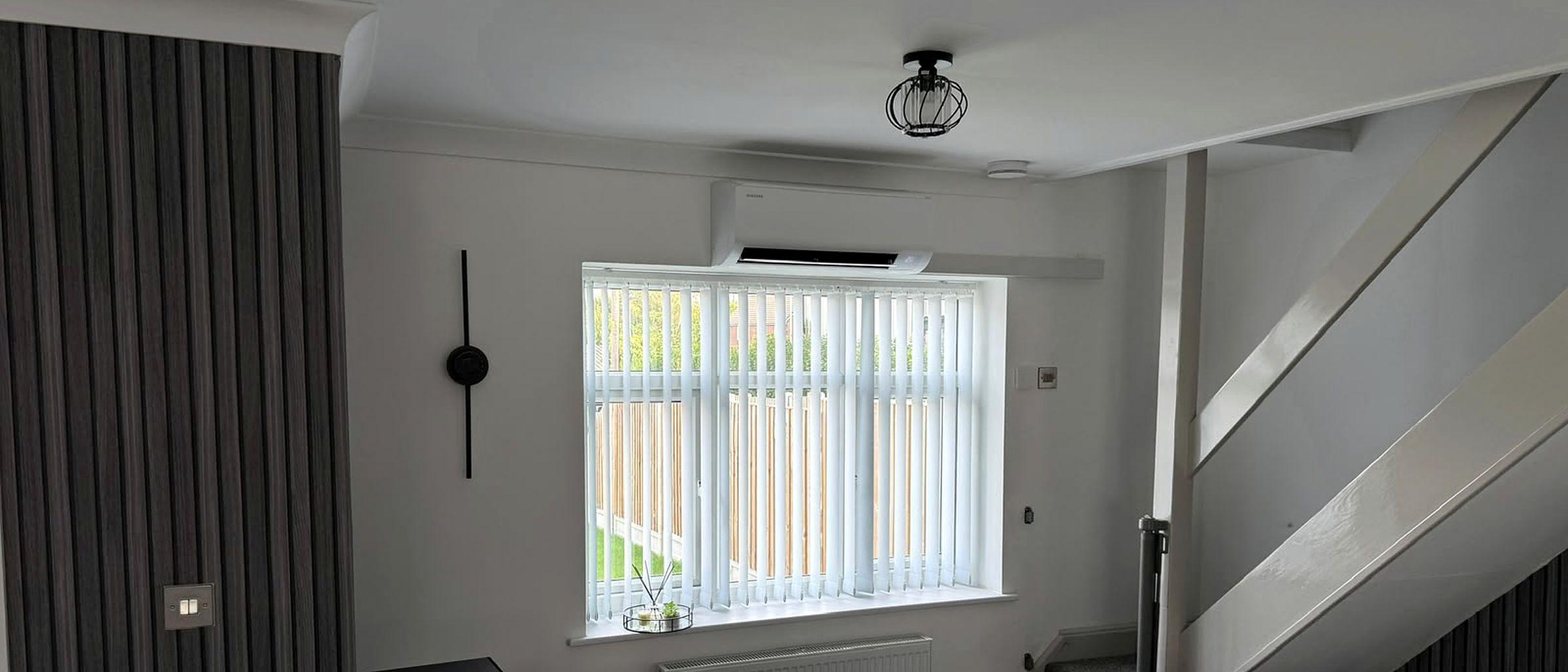
Real installs by our own team
A real install by our own team. The price on our list is the fully installed price, inc VAT.
Is a wall-mounted air conditioner too loud for a lounge while watching TV?
Usually not. The noisy parts of a split system, the compressor and the big fan, sit in the outdoor unit. Indoors you mostly hear moving air, and most units have a quiet mode for evenings. As an example, Samsung lists the 3.5kW WindFree Comfort on our Bronze package, the size most lounges need, at 16 to 38 dB(A) indoors, from the quietest setting to the fan on full. Any unit is louder on full power, so it helps to cool the room down before you settle in, then turn the fan down.
What size air conditioner does a lounge need?
Our size guide puts a standard living room up to 35 square metres at 3.5kW and a large living room or open space up to 50 square metres at 5kW. Rooms over 50 square metres are quoted on request. Big windows, south-facing glass or a high ceiling can push a room up a size, so we check it at a free survey.
Can a wall-mounted unit heat my lounge in winter?
Yes. Every system we fit is an air-to-air heat pump, so the same indoor unit cools the lounge in summer and heats it in winter.
Where is the best place to put an air conditioner in a living room?
High on a wall where the air can travel across the room, not aimed straight at the sofa. We also look for a short, tidy pipe route to the outdoor unit and keep the unit out of direct sun. If the unit is not on or next to an outside wall, a condensate pump is needed to carry the water away.
Do I need planning permission for a wall-mounted air conditioner?
Most homes can fit one under permitted development without applying for planning permission, but there are limits. Listed buildings need consent, and some conservation areas have extra rules. Our planning permission guide explains where the rules apply.
How often should a lounge air conditioner be serviced?
We recommend a service once a year. It keeps the filters and coils clean, checks the drain and the refrigerant circuit, and helps the system keep running efficiently. Check your manufacturer's warranty terms too, as some set servicing conditions.
Read next
- Living room guideSize, placement and noise for a living room
- Fixed pricesEvery brand and size, from £1,400 fitted
- InstallationWhat a home installation includes, step by step
- Air conditioning for open-plan livingKitchen heat, big glazing and one shared volume of air make open-plan spaces harder to cool evenly. Here is how we size, zone and place a system so every end of the room is comfortable.
Get your fixed price
Send the room, the floor area if you know it, and a photo of the wall. You will hear back the same day with the fully installed price from our list.
- Call 01268 264002Speak to the team directly
- Message us on WhatsAppSend a photo of the wall from your phone
- info@
essexhomeairconditioning.co.ukFor plans, drawings or anything long